

What material(s) do you use in your sculptures?
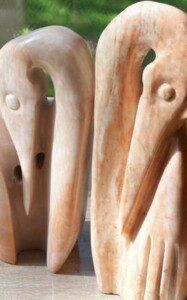
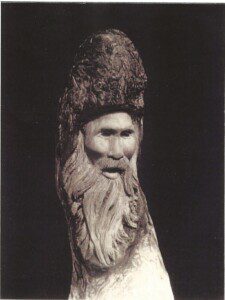
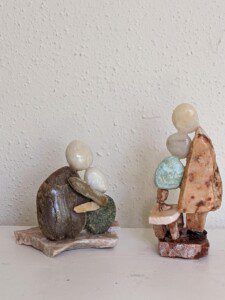
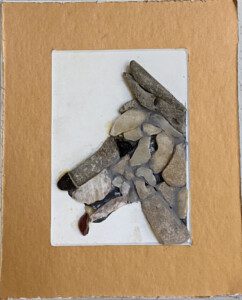
“I primarily use “found objects” from nature and try to maintain or preserve as much of the natural features as possible to showoff the original formation, distinctiveness and natural beauty it possesses. I use primarily metal, wood and stone. I use what is given rather than create out of nothing. I tell students to know your environment and use what you have, rather than complaining about what you don’t have or wished for.“


What is your primary forming method?
“Mostly it is by hand and eye. I don’t press the material into forms, jigs or molds or defined patterns.“


What is your favorite surface treatment?
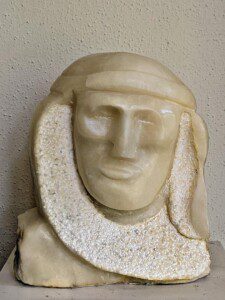
“For a textured surface, I use hammer, files, chisels and rasps. For a smooth unblemished surface, I use grinders and sandpaper of various grits.”

What are your favorite Tools?
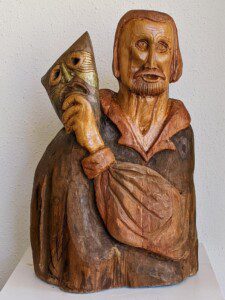
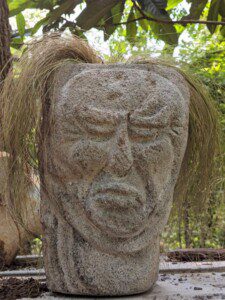
“Many of my tools are hand-made in blacksmith fashion with hammer and forge. Different tools are favored with different materials.”

Describe your studio environment.
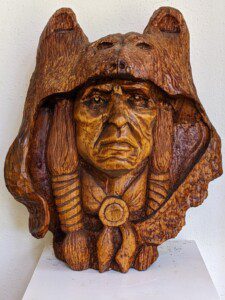
“I never established a proper studio as my materials vary. I usually use the backyard and its open air for dust control, light, etc. I began art as production rather than observation in retirement and we put our 3 sons through 3 different Universities and did not invest in the proper expensive equipment, tool and supplies for an an adequate working shop. It is all rustic and crude.“


How/Where do you market and sell your artwork?
“I do not advertise and as a one-person operation, I do not maintain a web-site or social media platform by intention and all commissions come by word of mouth. I participate in art-exhibits and shows, but primarily for communication and not essentially for sales.”


What sparks your creativity? What drives you to create?
“Some form of beauty in nature, history and human nature is probably one strong impulse behind most pieces. Some historical event or human behavior illustrate a value threatened or subject to being lost. (Something that reveals a contrast between what one desires and what really is.) Not being market driven, I am not boxed in to what people want but can express myself l honestly, which is a task in itself. Art struggles to be honest and truthful and that is not always appreciated and rewarded… “

Did you come to sculpture from a different career? Tell us about your journey to becoming a sculptor.
“While I always admired art, it was only in retirement that I had time to pursue it seriously. I never received any formal or academic training in art and it all springs from desire rather than from any training or destiny. To me, “creation” is an on-going process and not a finished, completed work, which we are to imitate, preserve or exalt. For me, art is a process of “Discovery” more than Creativity, so venerated and exuberantly proposed by the vaunted and romantic “creative imagination” of today. All of which is simply to say that while art brings pleasure and satisfaction, it is not self-serving. I admire fine craftsmanship in any and every field as it allures and invites discovery and is not limited or confined to a few highly talented people conscripted by wealth and power connections. True art is in the service of Beauty, not in the total service of power and elitism. So art is neither a leisure-time pursuit or egg-headed vocation, but a “calling” to be entered and shared by everyone in some aspect of life, which honors art’s basic intent and contribution. This is not populism; it is fidelity to an intention on keeping human life human – not subhuman with its deceptions on the one hand, nor superhuman on the other hand. After all, Michelangelo painted some angels without wings … “


How have you have taken your experience as a well-established maker in the field and passed that knowledge along to other artists?
“While respecting and pursuing knowledge by taking workshops, seminars, etc. art is not limited or confined to accumulated knowledge or technique. ( good photography requires more than a good camera, but cannot be made without one). Opening the door to discovery is more than factual knowledge or inspired verbal insights. ( some great artists are not good teachers and some great teachers are not superior artists.) As in all other fields, art is built on the foundation of Relationships – to history, persons, concepts, principles, reality, etc. and to that extent art is forward-looking and not just backward looking and it reveals something longed for or passionately missing. Discovery means that there is a new experience, new learning, new awakening, renewed reality and excitement just around the comer. Art is not only about restoring something old; it is about the birth of something new and calls one to participate in a miracle. Art can ask the ancient question about “Being” – that is ”Who are you?” But more often it asks the active question about “becoming” – who are we becoming or what are we growing into?… ”

What’s the best advice you’ve been given by a fellow maker, mentor, or teacher?
“I have a friend, born Dutch but born in South Africa, Dr. John W. de Gruchy, who was an outspoken critic who resisted apartheid and was prominent in its overthrow. He wrote a book “Christianity, Art and Architecture”, one of the earliest books on theological aesthetics. (2008) He said his eyes were opened, not by a fellow theologian, but by an architect, who took him on a walking tour of the cheap housing constructed in a ghetto. He told de Gruchy that evil, whether in society or in politics, manifests itself in ugliness and that ugliness cannot be eradicated by legislation, wealth, might, force, protectionism or good intentions, but only by those who stood for Beauty in social and political contexts. Beauty is the vaccine against all forms of ugliness, whenever and wherever they are found in high or low places. While it may be a first step along the way, no one can become an artist by simply learning “about” art. It we are made in the image of God the Creator, then an artist, artisan or craftsman is not a special kind of person, but everyone is a special kind of artist. artisan or craftsman in one way or another… ln a scene from WWII, after the smoke cleared from a battle, soldiers discovered that a beloved comrade had been killed. They wanted a decent funeral, but when they inquired about a celebrated cemetery connected to a local church, the priest told them that the cemetery was reserved for Catholics only. But they could bury their comrade right up against the wall on a spot outside the walls. This was done with love and devotion, but during the night the friends were restless. The next morning people discovered that during the night a section of the wall had been removed and reconstructed so that now the soldier’s grave was inside the wall. God uses art to move the wall, so that now we are all included inside the wall and we belong to the Kingdom of God’s Love and Beauty… “

TSOS Member Profile: C.D. Weaver
Bio:
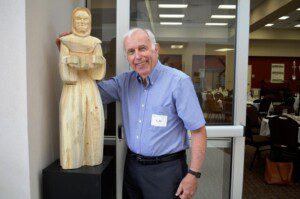
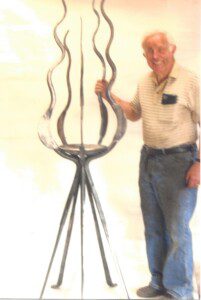
Clarence DeLeon Weaver (“C.D.”) was born in Virginia in 1934 and grew up in a small industrial town around Civil War battlefields, that conditioned his opinions about war. Earning a B.A. in undergraduate study, he enrolled in Columbia Theological Seminary and at its Graduation was awarded a financial fellowship, enabling him to do postgraduate study overseas. He studied with Karl Barth, the leading theologian of he day at the University of Basel, Switzerland. Later he studied at the University of Tübingen in Germany. Returning to the U.S., he served for twenty years as the minister/pastor of a Presbyterian church in the University town of Gainesville, Florida. He was invited to join the staff of the Austin Presbyterian Theological Seminary and in 1983, with their three sons, they moved to Austin to accept the offer.
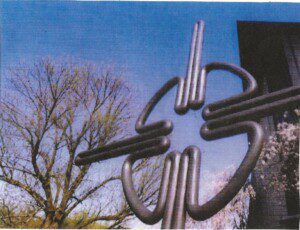
He served at the seminary for almost seventeen years as Dean of Students and Pastor to Students, working with students of 21 different denominations educating them to be ministers, pastors, counselors and church leaders in organizations and church efforts in this country and around the world. He retired in 1999-2000 and continued to reside in Austin, where in retirement he began to use the arts as another kind of language and the carrier of truth, virtue and values in the effort to keep human life human, not subhuman nor superhuman. He experimented with metal arts, wood and stone carving using mainly “found wood” and other forms of nature. He approaches art as a process of “Discovery” instead of “Creativity” and says that an artist is not special kind of person, but every person is a special kind of artist, whether they have realized that or not. His work is to be found in. churches, educational institutions and originations, homes, businesses and private collections.
.